

Weekly SPARK - Experiment 10
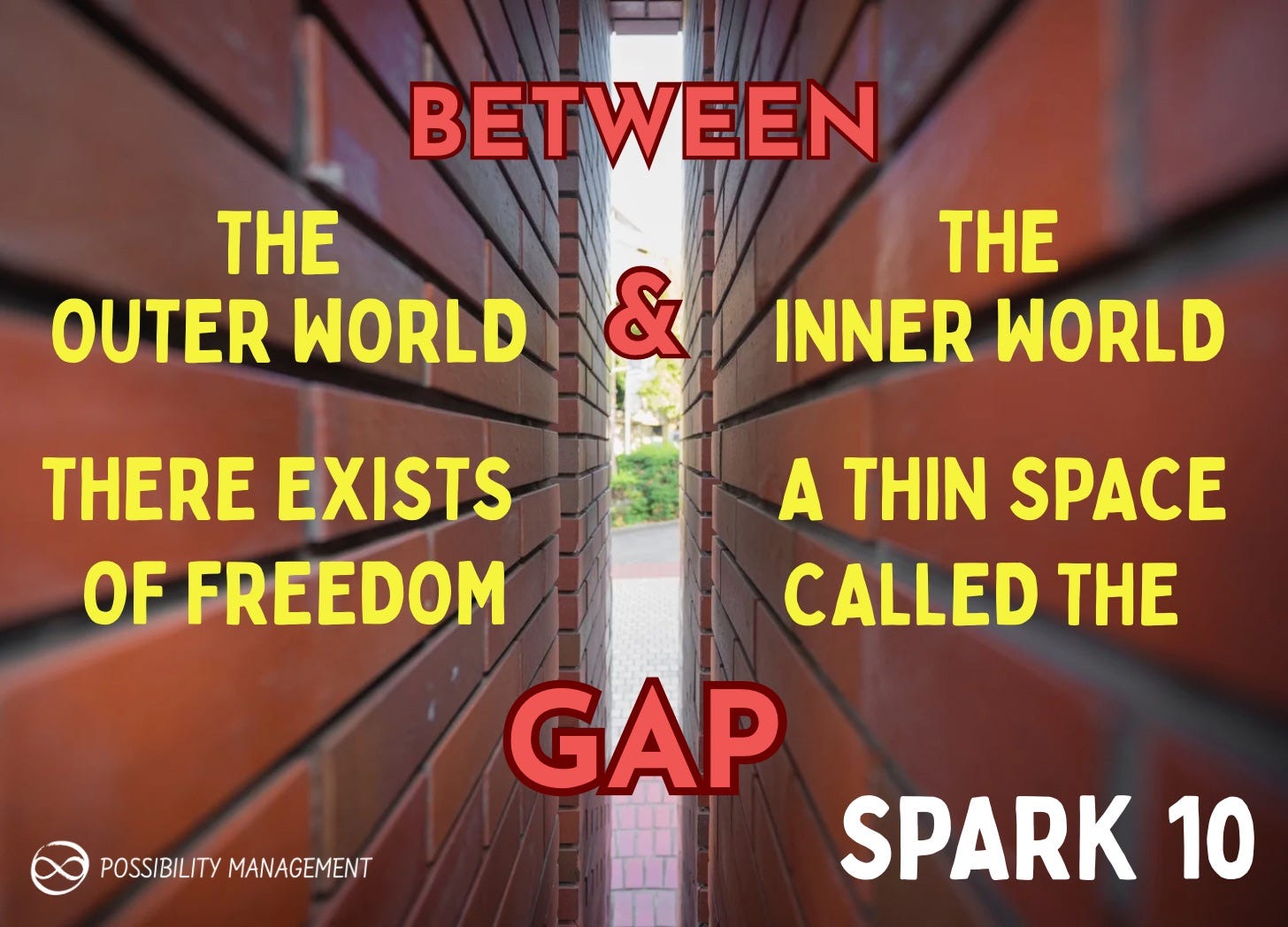
Between the outer world, and the inner world, there exists a thin space of freedom called the gap.

SPARK EXPERIMENT
Specific Practical Application of Radical Knowledge
SPARK- Experiment 10
Between the outer world (sights, sounds, physical sensations, smells, experiences, relationships, external conversations, etc.), and the inner world (concepts, memories, reactions, images, internal conversations, etc.), there exists a thin space of freedom called the gap.
(Matrix Code SPARK010.00)
Notes: Through a webwork of cross-wirings and connections, your Box normally makes the gap invisible and inaccessible. The webwork causes you to relate to the outer world and the inner world as if they were welded seamlessly together. When you use that model of reality then every stimulus in the outer world (conflict, accident, situation, crisis) creates an automatic mechanical response in your inner world (offense, terrible self-image, self-recrimination, justification, superiority). Likewise, every experience in your inner world (embarrassment, disgust, silly comment, strategic gesture) automatically and mechanically gets expressed in your outer world (status positioning, criticism, name-calling, teasing, gossip).
What this SPARK says is that your interactions do not have to be shaped by knee-jerk reactions. What you experience does not have to be automatically welded to what you express. Your inner world and the outer world do not have to be rigidly linked. It is possible to locate and enter the gap between the inner world and the outer world.
By discovering a way into the gap you take possession of a completely new set of conditions. You gain access to a wide new variety of options to choose from. These new options are non-linear options. That is, they do not necessarily directly follow from the original stimulus in an ordinary fashion. Circumstances become less relevant because when you have discovered the gap there is no longer a direct mechanical connection between the outer world and the inner world. When your boss bursts right into your office again without knocking you can say, “That’s something I really love about you is your enthusiasm for our work together!” When the waiter comes to your table after having ignored you and your partner way too long, you can say, “Thank you for giving us the private space to be together today.” When your partner arrives late to an appointment with you, you can say, “It was so intense for me waiting here for you that I now know how important you really are to me.” When your main client calls to cancel their contract you can say, “My company can only be successful when your company is successful. Thanks for the feedback.” You begin creating results that are independent of circumstances. Actions and ideas from the gap may be radically new, unprecedented, unexpected, unreasonable, and illogical. They may also be utterly simple and exceptionally effective.
Experiment: Gain dexterity with going into and out of the gap. The instruction sounds useful and adventurous, but just exactly how are you going to do this? Being in the gap is a recognizable experience for almost everyone. That experience has been called “the magic touch,” “the flow,” “cloud nine,” “being on,” “no mind,” “soft eyes,” “true love,” “light speed,” “being that which nothing can take root in,” etc. The way to enter the gap between the outer world and the inner world starts with making the distinction about the gap, that the gap exists. From there the distinction is held through splitting your attention, placing part of your attention on the manifestations and sensation of the outer world, placing another part of your attention on the manifestations and sensations of the inner world, and leaving the rest of your attention free-floating so as to notice and work with what arises in the gap. Here are three ways to practice entering the gap:
1) Accept an invitation to an informal dinner party where people are relaxed and interacting in a friendly social atmosphere. Select 5 minutes in the middle of the party. During these 5 minutes neither smile nor laugh, no matter what is said or what happens. If you can avoid the impulse to laugh you may be in the gap.
2) Go to a romantic or adventure movie at the cinema. Sit two-thirds of the way back from the screen in the center of the row. For the whole movie do not look at the screen. Only look at the other people who are in the theater. If you can avoid “snapping into” the space of the story in the movie and never forget that you are at a movie theater you may be in the gap.
3) Spend a day at an industrial trade show fair. Walk up to booth after booth. No matter what the sales representative says to you, you say nothing at all in return. Make no faces, use no gestures, and offer no explanation. Stay completely relaxed and alert, looking at whatever interests you at the booth. After awhile leave without warning and go to the next booth. If you can avoid the automatic reflex of speaking when spoken to you may be in the gap.
What is in the gap? (Nothing.) Encountering pure nothingness can be exceptionally valuable. For example, entering nothingness previews all true invention.
What is possible in the gap? (Go find out for yourself! We’re not telling you everything!)
SPARK - Experiment 10 in other languages!
If you want SPARK in your own language, join the SPARK Translator Team by contacting Clinton Callahan at clinton(at)nextculture.org.
May the gap be with you,
Your random SPARK Generator.
To be in the world, but not to engage with the world, can be enlightening and a bit dangerous. Situational awareness is the key to avoiding dangerous attention. The world may seem asleep - but it does have teeth. The trick is to move, unseen, unless you choose to engage and create an effect. The quieter you get, the more you see. Step away from social consensus carefully.